Most church financial problems do not begin with bad intentions. They often begin with good people carrying too much responsibility without enough structure around them.
That is why separation of duties matters.
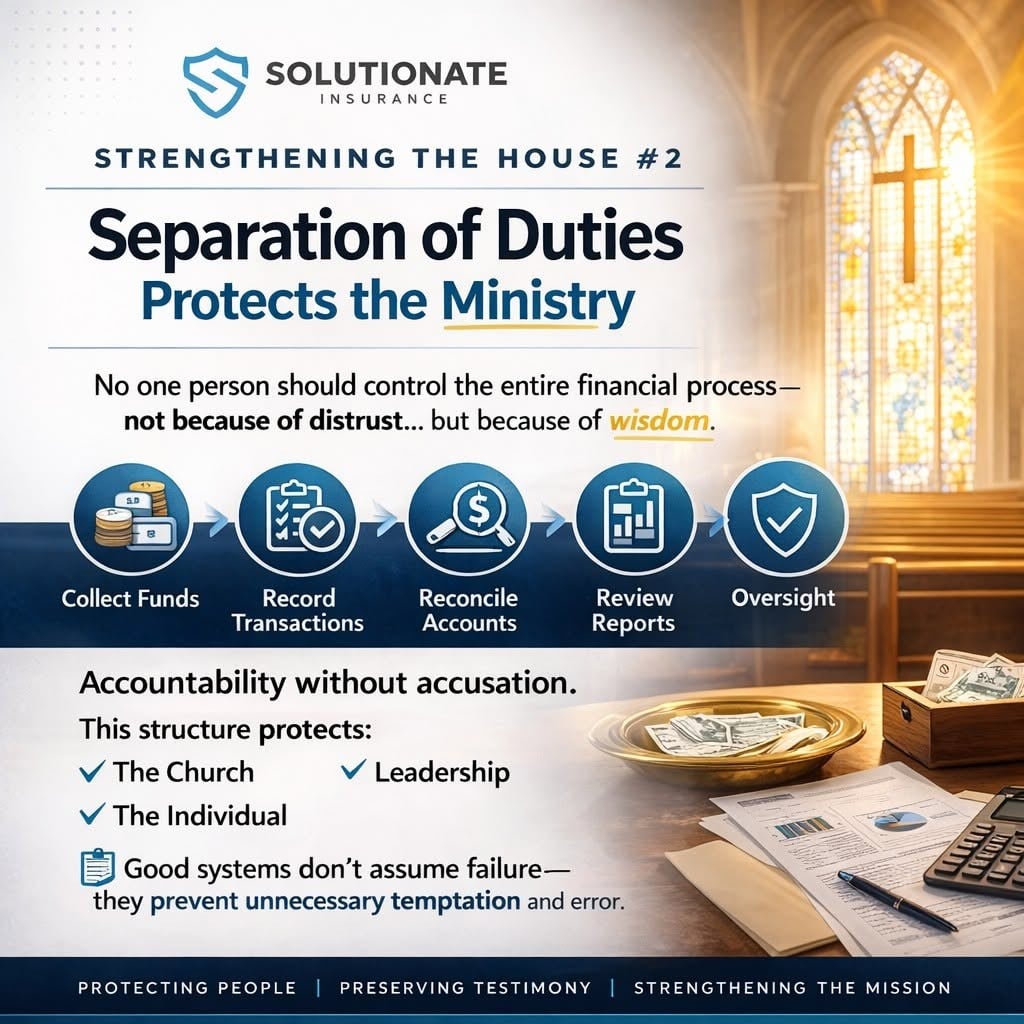
No one person should control the entire financial process in a church. Not because the church assumes failure. Not because leaders are suspicious. Not because every volunteer must be treated with distrust.
It matters because wisdom builds safeguards before pressure, temptation, confusion, or error has a chance to grow.
In many churches, one faithful person may collect funds, record transactions, reconcile accounts, prepare reports, and answer financial questions. Sometimes that happens because the church is small. Sometimes it happens because volunteers are limited. Sometimes it happens because one person has always handled it and everyone trusts them.
I understand that reality. Churches often run lean. Pastors, treasurers, deacons, staff, and volunteers are already carrying full plates. But from a church risk management and insurance standpoint, concentration of financial control creates exposure.
A stronger process separates the key steps:
Collect funds
Record transactions
Reconcile accounts
Review reports
Provide oversight
That structure protects the church, but it also protects the individual. When duties are separated, no one person has to carry the weight of suspicion, pressure, or complete responsibility alone.
This is accountability without accusation.
Healthy financial systems help preserve trust between pastors, leadership, members, and volunteers. They also create documentation that shows the church is actively managing its risk. That matters when questions arise, when records are reviewed, when a claim occurs, or when an insurance carrier evaluates the overall risk profile of the ministry.
Good systems do not assume failure. They help prevent unnecessary temptation and error.
For churches, risk management is not only about buildings, liability coverage, workers compensation, or church insurance premiums. It is also about stewardship. It is about creating simple, repeatable processes that protect people, preserve testimony, and strengthen the mission.
A few practical steps can make a meaningful difference:
Have at least two unrelated people involved when funds are counted.
Separate the person who records deposits from the person who reconciles bank statements.
Require regular financial reports to be reviewed by designated leadership.
Keep written procedures for offerings, deposits, reimbursements, credit cards, and approvals.
Document who is responsible for each step, and review the process at least annually.
None of this has to be complicated. The goal is not bureaucracy. The goal is clarity.
Church leaders are called to care for people, guard the ministry, and handle resources faithfully. A simple separation of duties policy helps accomplish all three.
At Solutionate Insurance, we help churches think through risks like this before they become problems. Strong church insurance is important, but strong systems are part of the protection too.
Protecting people. Preserving testimony. Strengthening the mission.
#ChurchInsurance #ChurchRiskManagement #MinistryLeadership #ChurchFinance #ChurchStewardship #HouseOfWorshipInsurance #ChurchSafety #RiskManagement #ChurchLeadership #SolutionateInsurance